InstantLoop - Instant Solution for Loop Station
An intuitive, Logic Pro & Ableton Live inspired loop station that runs instantly on any devices. InstantLoop lets musicians and beatmakers record, layer, trim, and export loops in real time with circular visualizations and a performance-ready interface.

Project Overview
Related Fields
Web Audio, Music Technology, HCI, Interface Design
Tech Stack
React 18, TypeScript, Vite 6, Web Audio API, MediaRecorder, Canvas
Project Status
Long-term ongoing project (currently at v2.0.0, active roadmap)
Motivation & Design Goals
Hardware loop stations are powerful, but they can be expensive, opaque, and hard to customize. DAW-based looping (e.g., in Logic Pro or Ableton Live) is flexible but often feels heavy for quick idea capture.
InstantLoop asks a simple question: Can we build a musician-centered loop station that can be open and used instantly at any time on any devices when you come up with some inspiration, with the immediacy of hardware and the clarity of modern DAWs?
- Minimal cognitive load during live performance
- Clear temporal awareness via circular visualizations
- Zero-install, cross-platform, PWA-based workflow
- Strong privacy: all audio stays on the device
Interaction & Interface Design
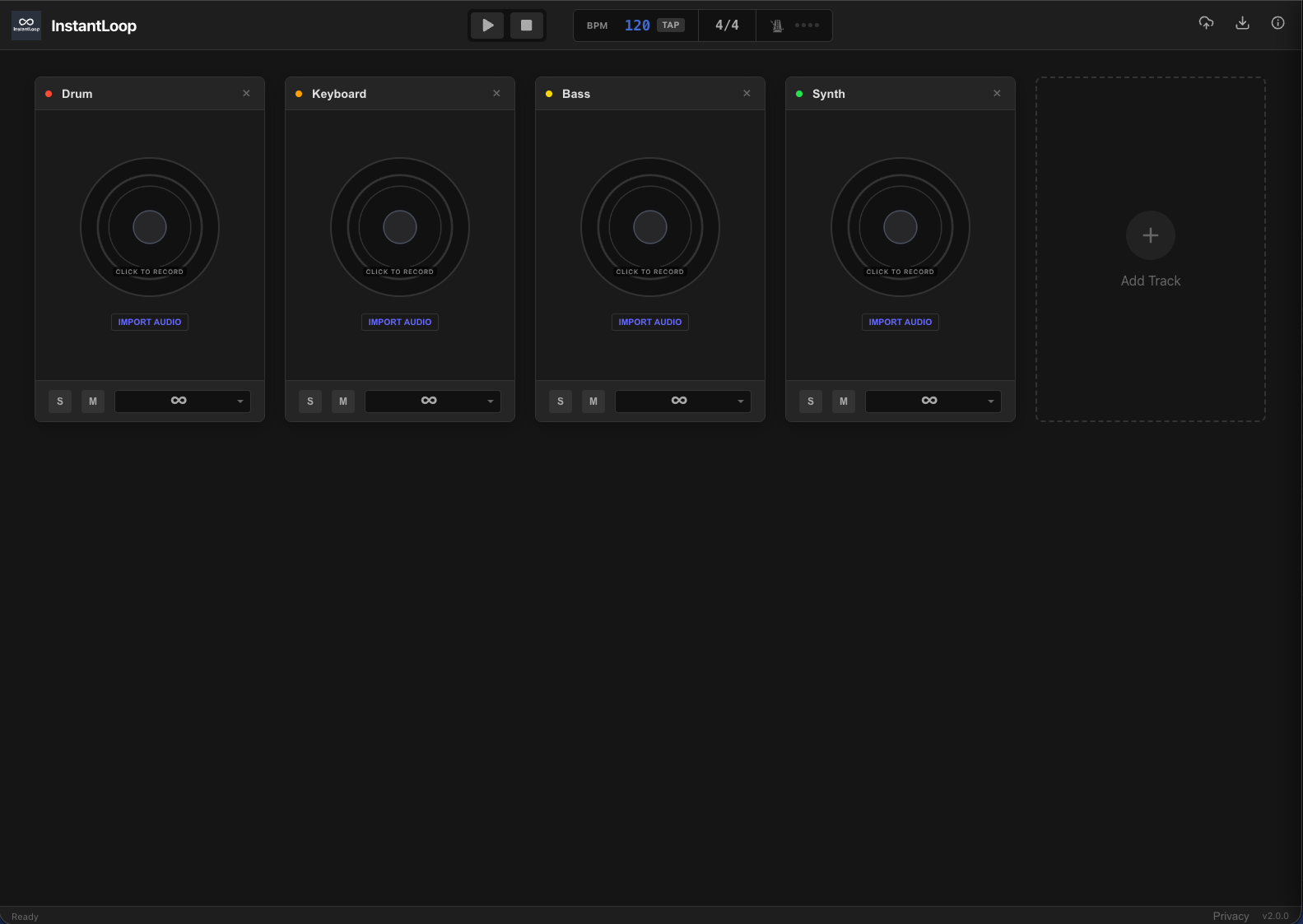
The UI is influenced by Logic Pro & Ableton Live's polished aesthetic while staying focused on looping. Each track is represented as a circular widget that combines:
- Recording / playback state (color-coded ring)
- Waveform visualization drawn via the Canvas API
- Timing feedback synchronized to BPM and time signature
Track cards expose controls that performers expect from hardware: Solo, Mute, bar length selection, per-track import, and editing.The global header hosts tempo controls (BPM, tap tempo, time signature), metronome, and project-wide import/export.
What's Built So Far
Recording & Playback
- Multi-track recording with independent loop lengths per track
- Auto-stop recording based on bar length, then seamless transition into looping
- Real-time circular waveform visualization with color-coded states (recording, playing, editing)
- Perfectly synchronized playback locked to a shared transport
Timing & Tempo
- Flexible BPM control (40–240 BPM) with drag and direct entry
- Tap tempo for rhythm-first workflow
- Multiple time signatures (2/2, 2/4, 4/4, 3/8, 4/8, 6/8) with a dynamic metronome
- Configurable bar lengths (1, 2, 4, 8, 16) plus an Infinite mode for long takes
Audio Manipulation
- Non-destructive trimming of loop start/end points using an interactive editor
- Reset to original at any time; original recording is preserved in memory
- Mute/solo per track with immediate feedback
- Independent track lengths allow polyrhythms and evolving patterns across tracks
Import, Export & Mixdown
- Drag-and-drop or dialog-based import for WAV, MP3, M4A, AAC, OGG, FLAC and other browser-supported formats
- Per-track export to 16-bit PCM WAV with timestamped filenames
- Multi-track export (selected stems) and a mixdown path that combines tracks into a single stereo file
- Export pipeline respects trimming and loops shorter tracks to match the longest selection while normalizing volume to avoid clipping
Architecture & Audio Engine
InstantLoop is built as a single-page React application with a clearly separated audio engine and UI layer:
- Web Audio + MediaRecorder: capture microphone input and manage decoded audio buffers
- Canvas-based renderer: draw circular waveforms and playback positions in sync with the transport
- Custom export utilities:
mixAudioBuffersandexportAudioBufferAsWAVhandle stem exports and mixdowns - Component structure:
LoopStationorchestrates state, whileCircularTrackandExportModalencapsulate track-level and export UI logic
The goal is to keep the architecture modular enough to support future additions like per-track effect chains, MIDI input, and session persistence without rewriting the core.
PWA, Mobile Experience & Privacy
Progressive Web App
- Installable on iOS, Android, macOS, and Windows
- Offline-capable once installed (no network required after first load)
- Responsive layout with stacked tracks on narrow screens
- Touch-friendly controls for editing loop handles on phones/tablets
Privacy & Data Ownership
- All audio processing is 100% client-side in the browser
- No audio is uploaded, stored, or logged on any server
- You retain full ownership of any loops or exports created with InstantLoop
- Closing the tab clears in-memory recordings unless you export them to disk
Roadmap & Next Steps (Long-Term Project)
InstantLoop is intentionally scoped as a long-term ongoing project. The current version focuses on rock-solid core functionality: timing, recording, editing, and exporting. The next phases push it further toward a fully featured performance tool and compositional sketchpad.
Near-Term Enhancements
- Per-track volume faders and pan controls (gain staging within the UI)
- Built-in effects: reverb, delay, filter sweeps, and gentle compression for more polished exports
- Keyboard shortcuts for record, mute/solo, and global transport to reduce mouse dependence on desktop
- Undo/redo for trimming and accidental track edits
Medium-Term Goals
- Session save/load so users can resume a looping session across browser restarts (with clear, privacy-conscious storage)
- MIDI controller support (e.g., mapping pads/knobs to record, mute/solo, and track selection)
- Input source selection for audio interfaces (beyond default system microphone)
- Basic audio quantization and grid-snapping for imported loops that drift slightly off tempo
Long-Term Vision
- Deep integration with performance workflows (live looping + backing stems + click tracks)
- More advanced timing tools: swing/groove presets, per-track bar counts, and evolving polyrhythm patterns
- A library of reusable loop templates, project presets, and potential collaboration features while still respecting local-first privacy
Each version aims to balance stability with experimentation, keeping InstantLoop usable as a daily tool while gradually growing into a more powerful live performance instrument.
Lessons Learned
- Good UX is a musical feature. Circular visualizations, color-coded states, and clear timing cues directly improve performance confidence.
- Web Audio is powerful enough for serious tools, but requires careful handling of latency, export pipelines, and browser quirks.
- Long-term projects benefit from a clear core. By locking in solid recording/playback first, future additions like effects and MIDI become much easier to design and reason about.
- Privacy can be a feature, not an afterthought. Keeping all audio local simplifies trust and makes InstantLoop feel more like a personal instrument than a cloud service.